Have you ever stopped to ask yourself what AI actually knows about you? If you type your name into a generative AI tool today, it might spit out a surprisingly accurate summary of your career, your interests, and your digital footprint. But as impressive as this is, it brings us to a critical crossroads in our modern history. We are standing at the intersection of a massive technological leap, and we face a monumental choice. Are we building a new Tower of Babel, or are we going to build something that actually brings humanity closer together?
By. Maria Frani Ayu Andari Dias
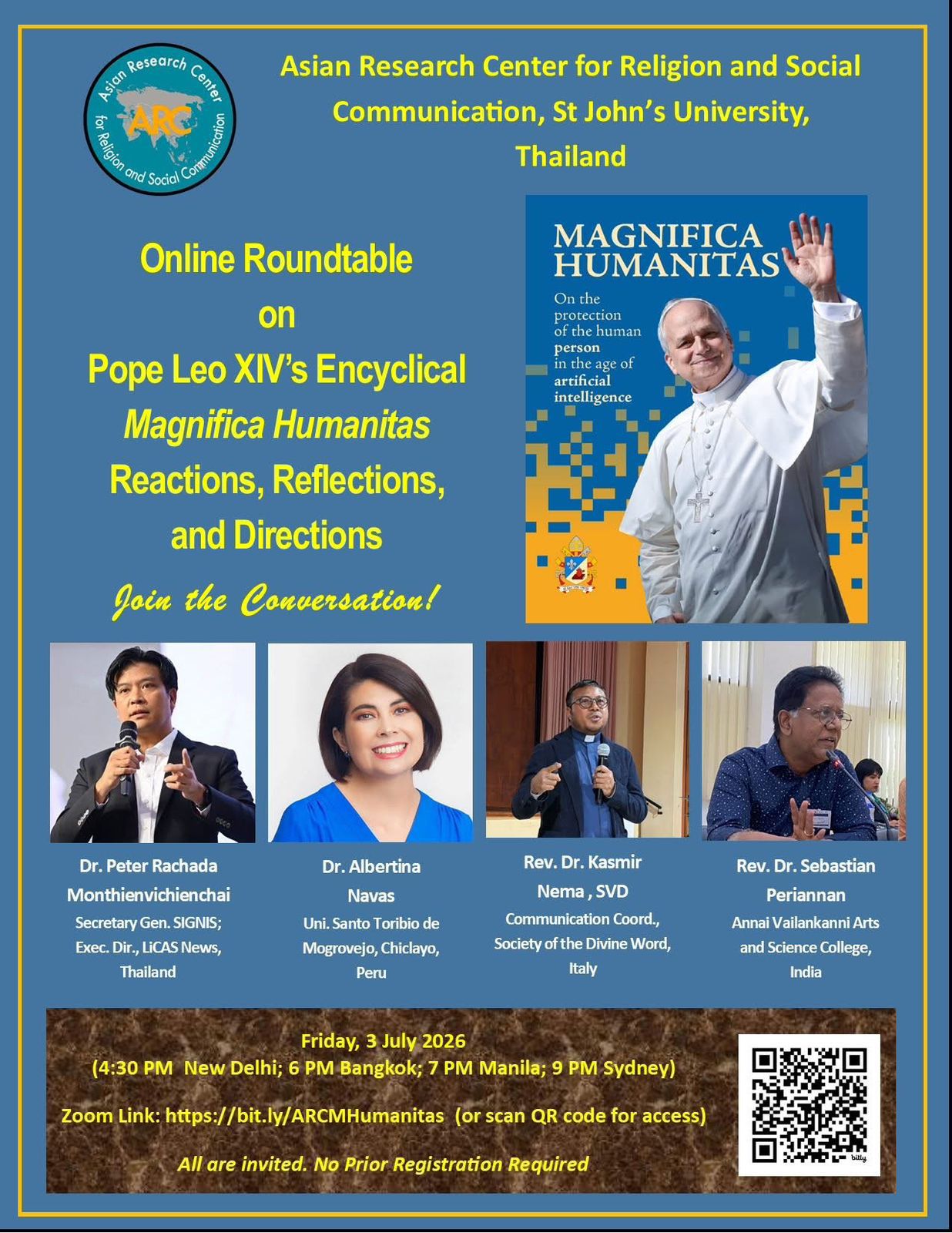
Recently, this exact challenge was tackled directly in an online roundtable titled “Pope Leo XIV’s Encyclical Magnifica Humanitas: Reactions, Reflections, and Directions.” Hosted by the Asian Research Center for Religion and Social Communication (ARC) at St John’s University, Thailand, the panel brought together distinct voices from across the globe to unpack what it means to stay human in the AI era.
The discussion was moderated by Fr. Anthony Le Duc, SVD, Executive Director of ARC, who framed the conversation by emphasizing that Magnifica Humanitas is not simply another Church document about emerging technologies, but a profound reflection on the human person.
Echoing Pope Leo XIV’s statement that humanity is “a desire, not an algorithm,” Fr. Anthony reminded participants that AI is ultimately an anthropological and moral question rather than merely a technological one. The encyclical, he noted, invites society to ensure that technological innovation always remains at the service of human dignity, relationships, and the common good.
(If you want to dive straight into the source material, you can watch their full, eye opening live discussion right here: Watch the Facebook Live Video)
Let us break down the core of their insights, guided by four of the main speakers, and explore what it means for our daily lives.
A New Chapter in Catholic Social Teaching: Rev. Dr. Sebastian Periannan
Rev. Dr. Sebastian Periannan — a pastor in Thanjavur, India, and a member of ARC’s editorial board — described Magnifica Humanitas as a major development in Catholic Social Teaching, updating the Church’s social vision for the digital age much as Rerum Novarum did for the Industrial Revolution. It reaffirms every person’s creation in the image of God (imago Dei), possessing conscience, freedom, and self-giving love — qualities no AI can replicate.
He highlighted the encyclical’s critique of the “technocratic paradigm,” where efficiency and profit threaten to become the measure of human worth, and its concrete concerns: workers displaced by automation, data and power concentrated among a few corporations, an “ecology of communication” against misinformation, and — extending Laudato Si’ — the environmental cost of AI infrastructure.
For the Church, he stressed, this means real pastoral action: AI ethics in seminary and school curricula, digital discernment for clergy, and transparency in the Church’s own use of AI. As he put it: “The future of AI depends not primarily on technological capability but on moral wisdom.”
The Flaws in the Machine: Dr. Albertina Navas
Dr. Albertina Navas from Uni. Santo Toribio de Mogrovejo, Chiclayo, Peru, an expert in strategic communications and digital marketing, held up a mirror to our current AI obsession. While it is easy to fall in love with the efficiency of AI, she warned of its inherent limitations.
AI is incredibly fast, but it is fundamentally blind to context. Dr. Navas highlighted the very real dangers of AI hallucinations, where the machine confidently presents false information, fabricated references, and illogical relationships. Furthermore, these algorithms carry the biases of their creators and the data they are fed, spanning cultural, socioeconomic, and gender lines.
Her solution is that we must learn to become the directors of this technology. She suggests transitioning from generic AI prompts to using highly specialized tools, always remembering that our human empathy and storytelling abilities are what truly connect us to audiences. Borrowing a powerful insight from Harvard Business Review, she reminded the audience: “AI won’t replace humans, but humans with AI will replace humans without AI.”
The Architecture of Visibility: Dr. Peter Rachada Monthienvichienchai
Taking the conversation into the ethics of our digital structures, Dr. Peter Rachada Monthienvichienchai, Secretary General of SIGNIS and Executive Director of LiCAS News, Thailand, asked hard hitting questions about why and for whom we are building these AI tools.
Dr. Monthienvichienchai pointed out that AI is constantly sold to us as a way to save manpower. But what absolute human values are being destroyed in the process? Drawing directly from the teachings discussed in the encyclical, he emphasized a profound truth: “Human beings can never be reduced to a profile, a datum, an algorithm.”
He challenged the audience to look at the “architecture of visibility” online. Are organizations and media outlets just chasing hollow digital engagement, or are they striving for real, meaningful connection? He warned against measuring success purely by what can be tracked by algorithms, like quarterly profits and click through rates, while ignoring the invaluable human elements that cannot be easily measured. As Agentic AI gains the ability to process more information than any single human could, he reminded us that humanity is about so much more than just processing data.
Rebuilding Like Nehemiah: Rev. Dr. Kasmir Nema, SVD
Finally, Rev. Dr. Kasmir Nema, SVD, Communication Coordinator for the Society of the Divine Word, Italy, brought the unique dual perspective of a priest and a journalist. He framed our current technological crisis through a powerful metaphor found in Pope Leo XIV’s encyclical Magnifica Humanitas: The choice between Babel and Nehemiah.
Fr. Kasmir explained that the Babel Syndrome happens when we treat human beings as mere projects to be optimized. Quoting the encyclical directly, he warned: “When efficiency becomes the ultimate measure of value, human beings are tempted to see themselves as a project to be optimized rather than as persons called to relationship and communion.”
The alternative is the path of the ancient leader Nehemiah. When Nehemiah rebuilt the ruined walls of Jerusalem, he did not just hand down a highly efficient blueprint. He assigned families and workers to build together. As Fr. Kasmir highlighted, Nehemiah “rebuilds relationships before rebuilding with stones.”
Fr. Kasmir stressed that we do not need to reject technology, but we must “disarm” it. We must prevent it from dominating humanity. He left us with one of the most striking direct quotes from the document itself: “No computational system, however sophisticated, can create a heart that gives itself, or a conscience that discerns good from evil.”
The Final Reflection: Who is Steering the Ship?
The insights from this panel leave us with a profound realization. Humanity flourishes not despite our limitations, but often through them. We are all carrying our own stones in this digital age. The question these experts leave us with is simple but heavy. Are you using your tools to build a towering, disconnected Babel, or are you helping to rebuild a community where empathy, truth, and human dignity still matter?
What do you think? Have you noticed AI changing the way we interact with each other in your own workplace or personal life? Watch the full discussion here and drop your thoughts in the comments below, let us keep the human conversation going!