

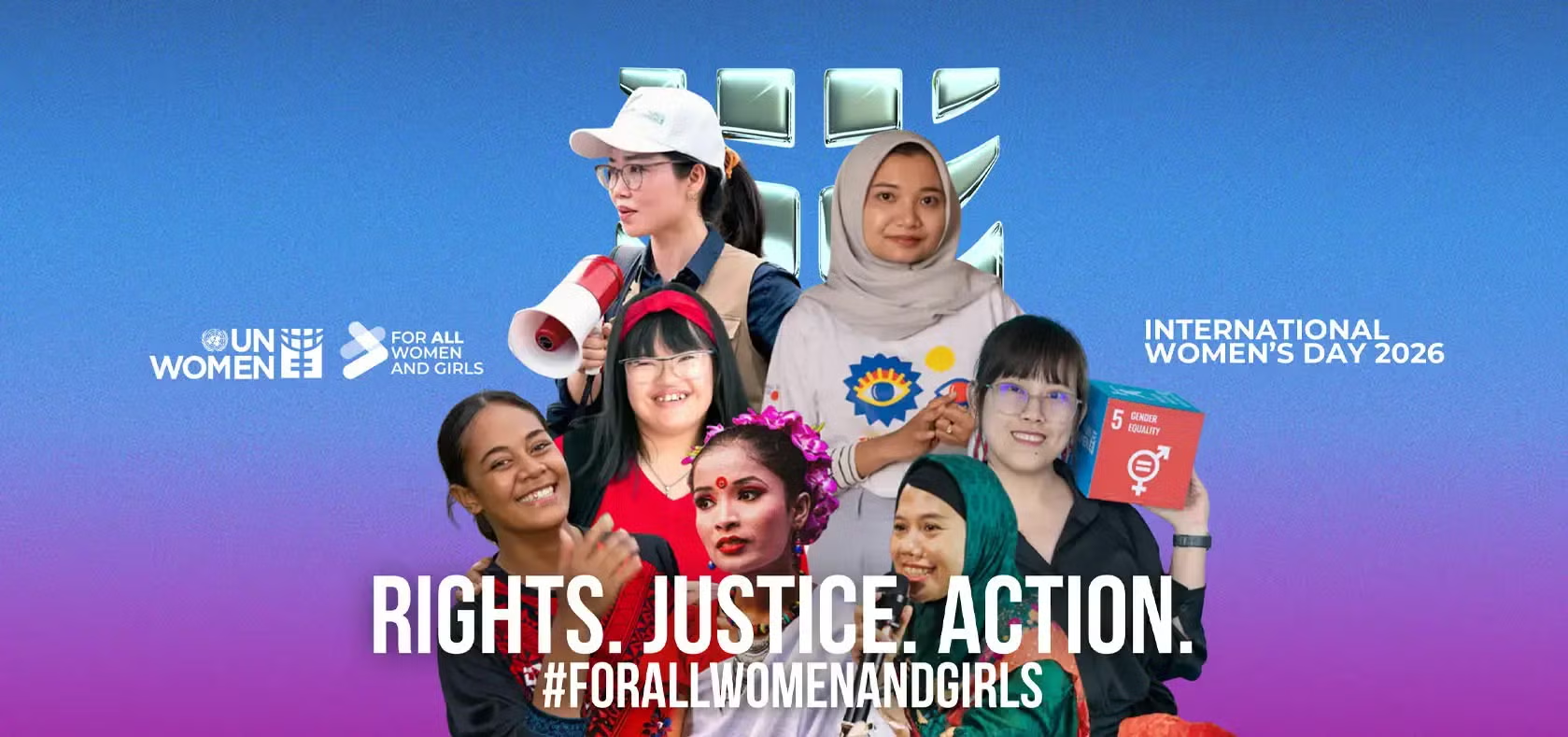
As the world paints itself purple to celebrate International Women’s Day, millions of women are still quietly asking a harrowing question: when will the world finally become a safe home for us?
By Sr. Herdiana Randut, SSpS*
Every year on March 8, women around the world commemorate International Women’s Day. The theme highlighted each year reflects the global context and the harsh realities faced by women. For 2026, the United Nations has officially introduced the theme “Rights, Justice, Action for All Women and Girls.”
From my perspective, this theme is not entirely new. The pursuit of rights and justice has long been a central concern for women and girls across generations. For decades, they have continued to search for these fundamental values. This raises a critical question: why must women keep searching? One devastating answer is that many women still do not experience what could be called a truly “safe home.”
A safe home should be understood as a social space in which women and girls enjoy their rights and receive justice. In such a space, there is no room for discrimination, sexual violence, or any degrading treatment. Yet, despite persistent efforts by advocates year after year, meaningful and lasting change remains painfully limited.
According to data from the Commission on the Status of Women (CSW), by 2025, approximately 840 million women worldwide have experienced physical or sexual violence at some point in their lives. This staggering statistic invites us to question how international law addresses such a global crisis.
Entering the twenty-first century, it is unfortunate that no country has fully succeeded in closing the legal gap between men and women. By 2026, women globally possess only 64 percent of the legal rights available to men. In fundamental areas of life-including employment, personal safety, property ownership, and pension systems—legal frameworks frequently continue to disadvantage women. Social norms that perpetuate inequality, combined with discriminatory structures, create systemic barriers. If progress continues at the current pace, it may take centuries to eliminate these disparities in legal protection.
The Indonesian Context
The global crisis of violence is sharply mirrored here in Indonesia. Media reports frequently highlight cases of violence against women, proving that such incidents have become a persistent, almost normalized, social concern.
National data indicates that violence against women is still dominated by sexual violence (38 percent), followed by psychological violence (28 percent) and physical violence (27.2 percent). Many victims are women in their twenties who often experience abuse within dating relationships—turning what should be a safe interpersonal space into a site of trauma. Meanwhile, women in their forties tend to face emotional or economic abuse.
Recent events have further shattered the illusion of safety. The community in Sikka, Maumere, was recently shaken by a human trafficking case linked to a nightclub involving twelve female victims. Shortly after, the public was horrified by the discovery of the body of a 14-year-old girl named Noni in Sikka Regency, East Nusa Tenggara. These tragic events force us to ask why such horrors continue to occur, knowing well that countless similar cases likely remain unreported or inadequately investigated.
Public responses to such incidents often vary widely, with many quick to blame families, the government, or tragically, the victims themselves. However, determining responsibility requires careful reflection from all sectors of society.
Moving Toward Concrete Action
The theme proposed by UN Women urges societies across the globe to address the structural roots of violence. International Women’s Day must not merely function as a ceremonial celebration; it must be a moment of critical resistance against political sexism and structural barriers. True social transformation requires concrete action aimed at preventing future violence, rather than simply reacting to it.
Several interconnected approaches are crucial in this effort. First, we must prioritize women’s economic and professional empowerment by providing tangible opportunities for them to recognize and develop their capacities. Whether it is a homemaker achieving financial independence through a small online business or a lecturer navigating the balance between her career and family life, economic autonomy remains a foundational pillar of personal safety.
Furthermore, this economic foundation must be reinforced by equal leadership opportunities and robust legal protection. Because gender inequality so often lies at the root of violence, women must be empowered to assume leadership roles across all sectors, backed by uncompromising legal frameworks. Finally, true progress demands the fostering of deep solidarity among women themselves. By supporting one another and bridging social divisions, women can cultivate inclusive, stigma-free environments and unify their voices in the pursuit of common goals.
Ultimately, reducing violence requires broad collaboration. Governments cannot act alone, and victims certainly should not bear the burden of change. Religious communities also play a paramount role, as true faith promotes values of justice, compassion, and protection.
Women in the Perspective of the Catholic Church
In 1988, Pope John Paul II issued the encyclical Mulieris Dignitatem, which reflects profoundly on the dignity and vocation of women. The document clearly affirms that the dignity of women is equal to that of men because both are created in the image of God (imago Dei). Rooted in Genesis 1:27, this principle leaves no legitimate space for discrimination within Christian teaching.
The Catholic Church strictly rejects interpretations that reduce women to objects or justify violence against them. Violence fundamentally arises from a failure to recognize the dignity of women as bearers of the divine image. Within Catholic tradition, Mary holds a particularly honored position, venerated as both Mother and Queen, embodying compassion and strength. Catholics are called to respect every woman as a reflection of Mary in the contemporary world. If individuals truly practiced the ethical teachings of their faith, acts of sexual violence would be far less prevalent.
Public policies and preventative measures are essential, but true transformation starts in the heart of society. The ultimate question remains: to what extent do we truly respect women in our daily lives, and what concrete contributions can we make to ensure that every woman, everywhere, finally finds a safe and dignified home?
*Secretary of Woke Asia Feminist (Japan)





A good reflection. Keep up the good work and continue to develop your writing spirit. It’s interesting that you brought up John Paul II’s encyclical Mulieris Dignitatem as a “conclusion” and signaled to readers that women have found a so-called “safe home” in the Catholic Church. I’m a little skeptical of this idea. In reality, societies in countries that have recognized equal human dignity are far safer for women than those in the Catholic Church. When it comes to the practice of justice in Church society, perhaps some Protestant denominations are far more realistic. John Paul II was the Pope who refused to ordain women as priests. Furthermore, there are numerous cases of sexual abuse committed by Catholic cardinals, bishops, and priests. In Indonesia, cases like this are also very common. Anyway, you’ve been involved in journalistic and academic work. Continue to develop your abilities. Your dream of realizing universal justice for all women may be difficult to achieve, but what you’re doing will certainly lead you to the realization of your own hopes.