
What happens when the water that defines your culture threatens to destroy it? Step into the heart of Banjarmasin, where a community is fighting climate injustice with the most powerful weapon they have: radical compassion.
Oleh: Maria Frani Ayu Andari Dias
Banjarmasin-Veritas Indonesia. If you open the pages of the Kamus Besar Bahasa Indonesia, the definitive dictionary of the Indonesian language, and search for the word “Banjar,” you will find a definition that speaks of order: a row, a line, or a series. It suggests a certain neatness, a linear progression of things arranged side by side. Yet, for those who breathe the humid, heavy air of South Kalimantan, Banjar is a concept that defies such simple geometric definitions. It is a heartbeat. It is a civilization carved by water, a culture built on the oscillating rhythms of the tides, where the boundaries between land and river are as fluid as the history that shaped them.
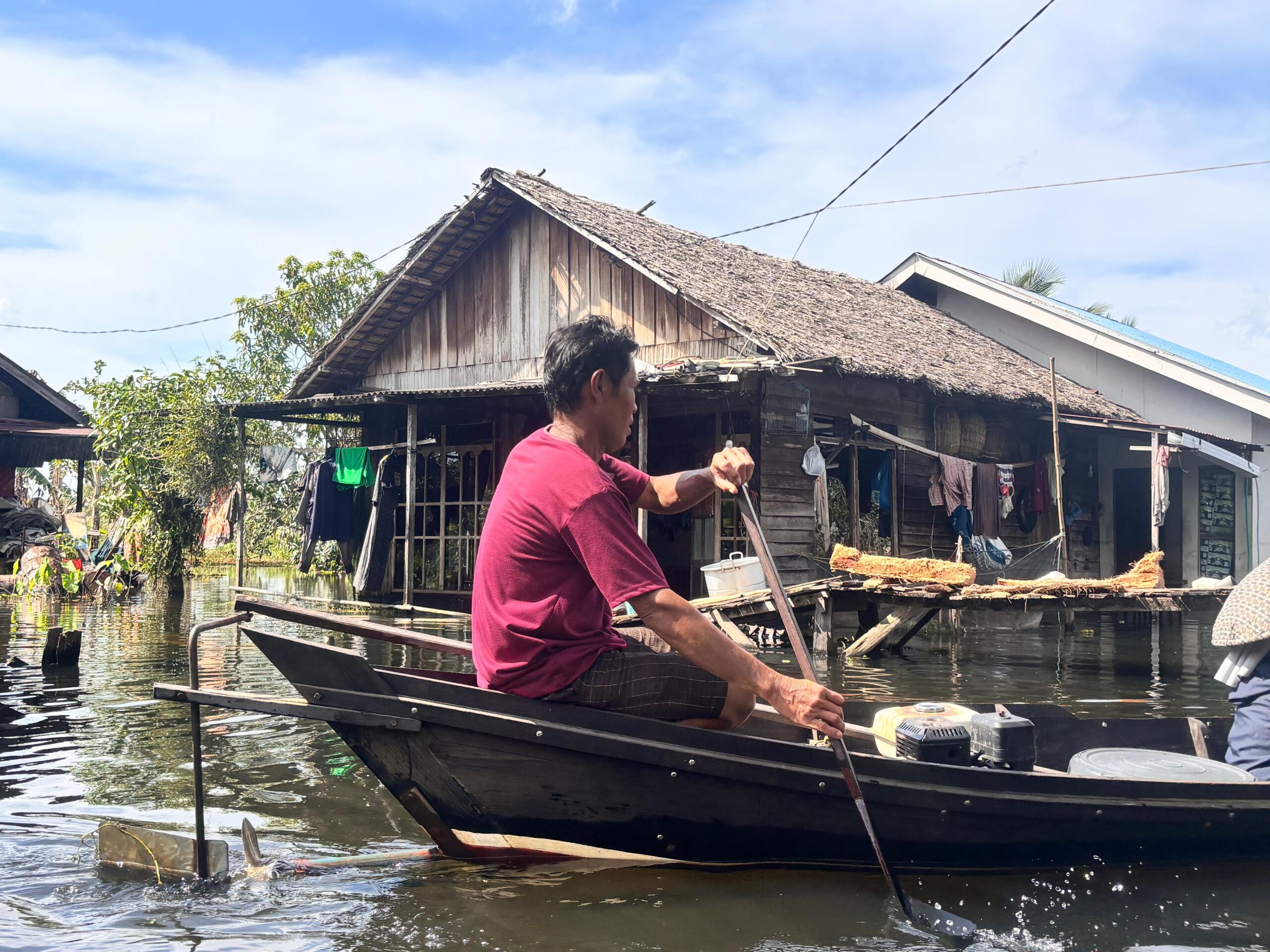
Here, on the southern edge of the massive island of Borneo, the concept of a “row” takes on a living, breathing form. It refers to the wooden houses standing on stilts, shoulder to shoulder along the riverbanks, their foundations submerged in the murky, nutrient-rich waters. It refers to the people—a distinct ethnic tapestry woven from the indigenous Dayak tribes of Maanyan, Ngaju, and Bukit, blended seamlessly with Malay and Javanese influences over centuries. To understand Banjarmasin is to understand the water. It is not merely a backdrop for the city; it is the protagonist of the story.
The City of a Thousand Rivers
Banjarmasin is affectionately known to the world as the “City of a Thousand Rivers.” It is a moniker earned not through hyperbole, but through geography. The city sits on a delta where the mighty Barito River meets the Martapura, creating a labyrinth of waterways that serve as the veins and arteries of the region.
The history of this aquatic metropolis is ancient. Long before modern roads sliced through the jungle, this was the domain of the Oloh Masih, or the Malay people of the village. The city traces its spiritual and political origins back to September 24, 1526, a date that marks the consecration of a low-lying settlement known then as “Banjarmasih.” It was here that Patih Masih, a chieftain with roots in Sumatra, laid the groundwork for a kingdom.
The settlement was born from the convergence of five smaller streams: the Sipandai, Sigaling, Keramat, Jagabaya, and Pangeran. These waters met to form a lagoon, a natural harbor that would become the center of trade, culture, and life. Under the reign of Pangeran Samudera, the first King of Banjarmasin, the village grew. Emboldened by support from the Sultanate of Demak to break free from the Kingdom of Negara Daha, Banjarmasin transformed from a mere collection of huts into a sovereign entity.
The name itself—Banjar—is believed to derive from the Malay term for “kampung” or village, or perhaps more poetically, from that very image of houses lining the river in endless rows. For centuries, the river has been the identity of the people. It is the highway for the kelotok (traditional motorized boats) that putter noisily through the morning mist. It is the marketplace where floating vendors sell fruit and fish at dawn. It is the bathroom, the playground, and the source of life.
But life on the river is a double-edged sword. The water that sustains can also overwhelm. The people of Banjar have always lived with the reality of tides—the air pasang (rising water). They build their houses on high ironwood stilts, anticipating the seasonal swell. However, in recent years, the rhythm has broken. The delicate balance between human settlement and the natural flow has been disturbed. Environmental shifts, deforestation in the uplands, and the changing climate have turned the familiar annual floods into unpredictable, devastating events. The water is no longer just a neighbor; at times, it becomes an intruder.
“Banjarmasin is not just a City of a Thousand Rivers, but a City of a Thousand Hands.”
A Mission Anchored in History
It was into this complex, water-bound world that the Sisters of St. Paul of Chartres (SPC) brought their mission more than half a century ago. The Congregation, known globally for its dedication to education and healthcare, did not choose a convenient location for their first Indonesian chapter. They chose the challenge of the wetlands.
On October 2, 1967, at the invitation of Bishop W. Demarteau, MSF—the then-Bishop of Banjarmasin—six SPC Sisters from the Philippines arrived in South Kalimantan. They stepped off the plane and into a world vastly different from what they had known, yet their mandate was clear: to serve the people of God, particularly the sick and the suffering. The Bishop entrusted them with a monumental task: the management and care of the Suaka Insan Hospital, the Nursing School, and the Polyclinic.
For decades, the Sisters have become an integral part of the city’s fabric. The Suaka Insan Hospital is not just a medical facility; it is a landmark of compassion in Banjarmasin. From their humble beginnings, the mission grew. Today, the center of the Congregation in the region has moved slightly inland to Banjarbaru, the provincial capital, but their heart remains tethered to the river city. They have dedicated their lives to the “hard” service—not just preaching from the pulpit, but washing wounds, educating nurses, and walking alongside the poor.
The charism of St. Paul is one of movement. It is a missionary spirit that refuses to be static. It compels the Sisters to go “to the ends”—to the margins where society often forgets to look. In January 2026, that margin was defined by the rising waters of the Martapura River.
When the River Breaks its Banks
The start of 2026 brought with it the rains, and with the rains, the sorrow of the flood. Reports began to circulate, echoed by environmental outlets like Mongabay, that the flooding in South Kalimantan was no longer a mere natural phenomenon but a “fruit of neglect.” This neglect is rooted in decades of unchecked land conversion, where ancient rainforests have been stripped away to make room for coal mines and vast palm oil plantations.
These extractive industries have degraded the watershed areas that once acted as the earth’s natural sponge. Without the forest to hold the soil and absorb the heavy tropical downpours, the water now rushes unimpeded into the villages below, leaving the poor to bear the brunt of an ecological crisis they did not create. It is a stark example of climate injustice, where the profits are extracted from the land, but the costs are paid by the people in rising water.
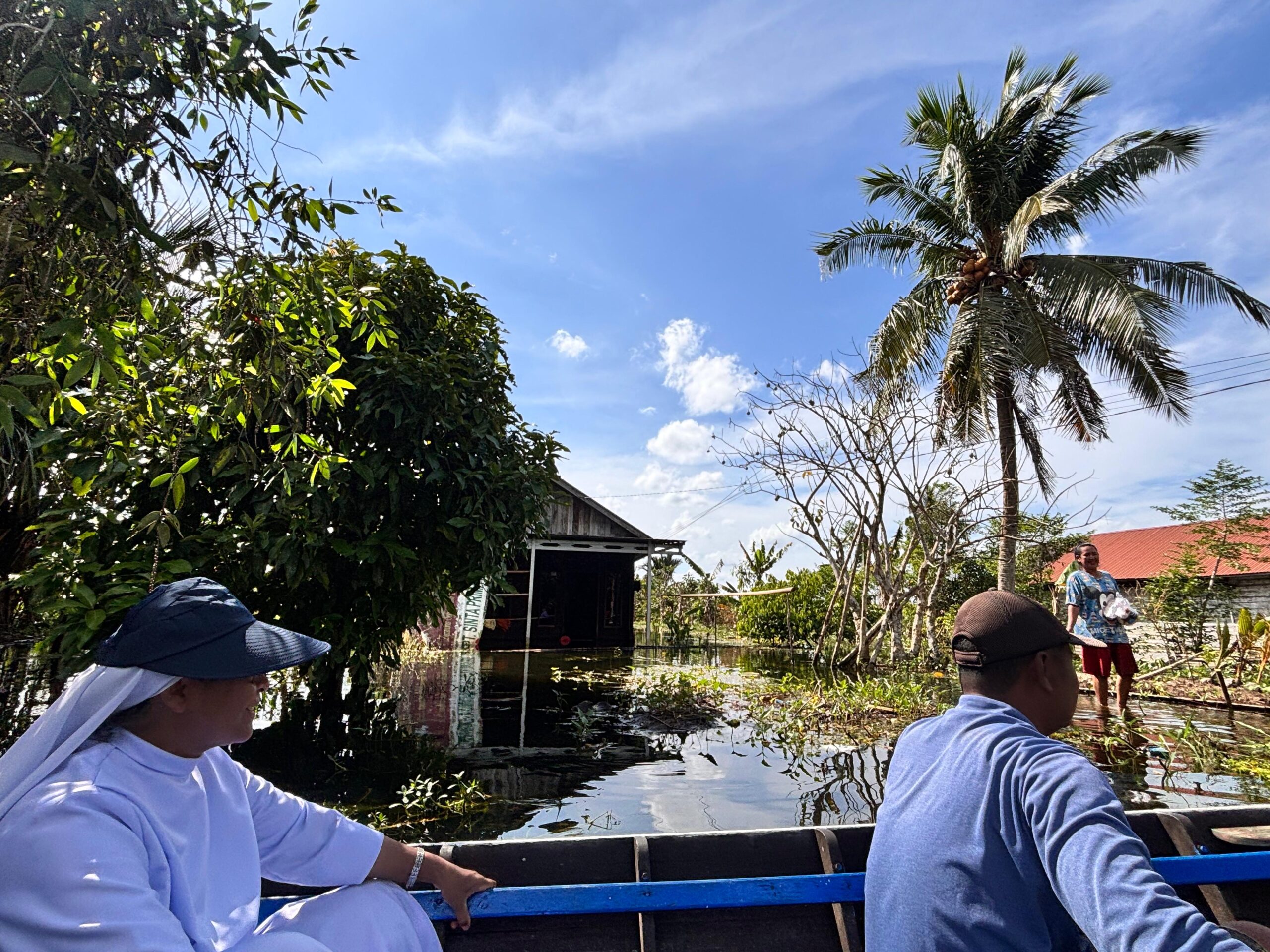
While the city center of Banjarmasin often has the infrastructure to cope, the peripheral villages do not. One such place is Desa Sungai Pinang Baru. Located on the fringes, accessible primarily by water, the village became a catchment for the overflow. Homes that were built to withstand a meter of water found themselves swamped by two or three. The river had risen to swallow the floorboards, turning living rooms into pools and forcing families to stack their belongings on rafts tied to their own ceilings.
For the academic community of the Institut Kesehatan Suaka Insan (Suaka Insan Institute of Health Sciences) and the SPC Sisters, the news from Sungai Pinang Baru was a call to action. It was not enough to pray for the victims in the dry comfort of the chapel. The theology of the Sisters is a theology of presence. To truly serve, one must get wet.
The Flotilla of Hope
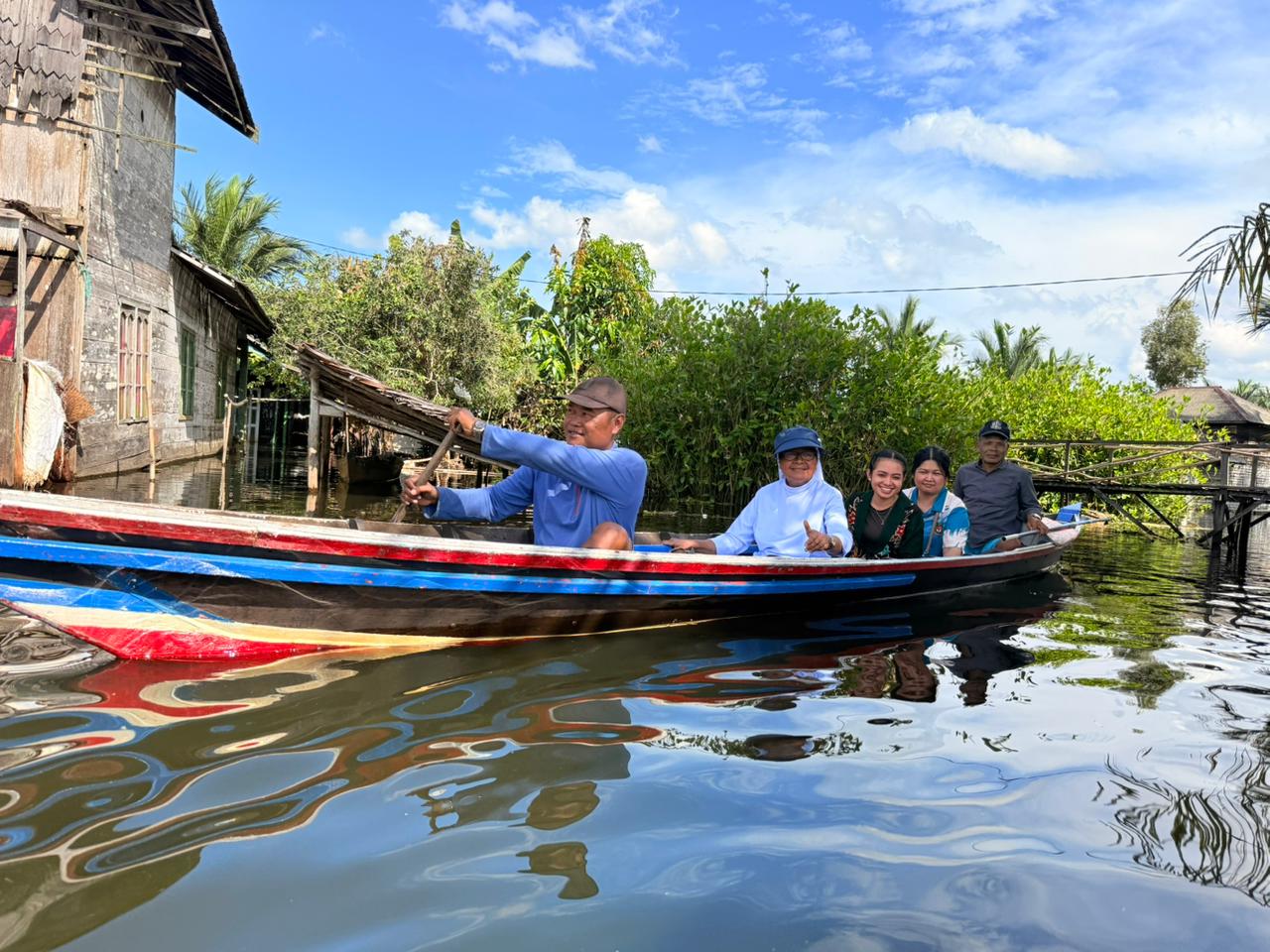
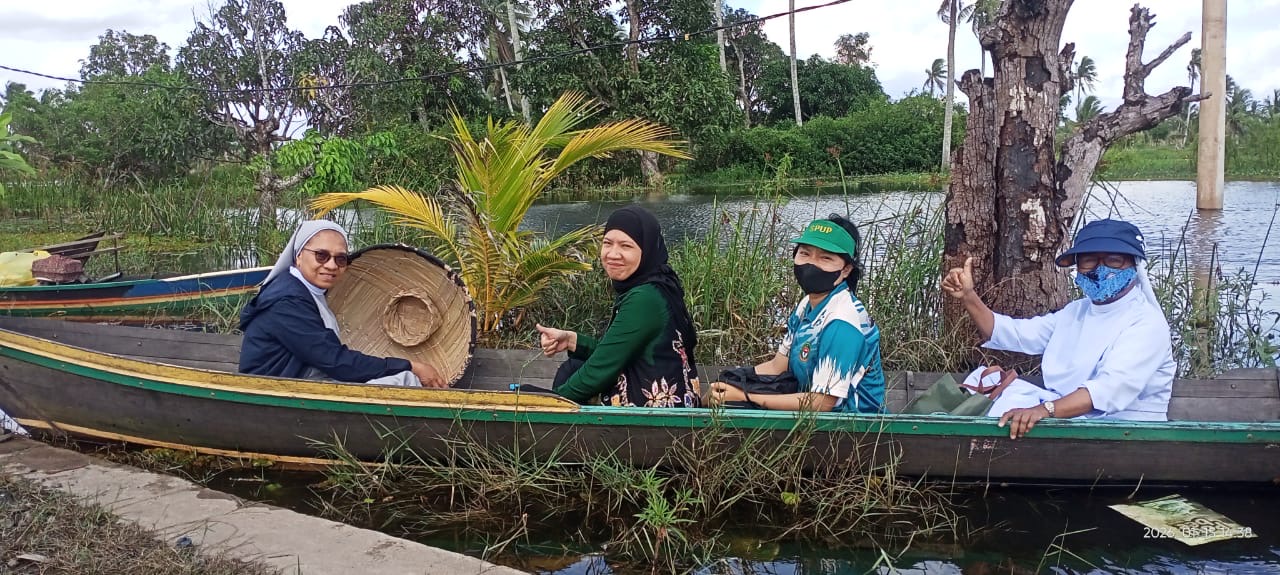
And so, a team was assembled. It was a diverse group, representing the full spectrum of the Catholic mission in Banjarmasin: religious sisters and lay professionals working in unison. Leading the charge were Sister Imelda Ingir, SPC, Sister Gertrudis, SPC, and Sister Regina, SPC. They swapped their clean habits for travel gear, ready to face the mud. Joining them were the dedicated employees of the Institute: Ermeisi Er Unja, Lucia Andi Chrismilasari ,Ovie, Maria Frani Ayu, and Oktovin.
But every expedition needs a navigator, someone who knows the secrets of the currents. For this, they turned to Kadir. Kadir is a staff member at the Institute, but in this context, he was much more. He is a son of Desa Sungai Pinang Baru. His own home was among those inundated by the murky waters. He was the bridge—the connection between the benefactors and the beneficiaries. He guided the team not just geographically, but emotionally, leading them into the heart of his own community’s struggle.
The journey to the village was a visceral experience. The team boarded small boats, the engines sputtering against the resistance of the swollen river. As they moved away from the city, the scenery shifted from concrete buildings to the lush, waterlogged greenery of the riverbanks. The water was a thick, ochre brown, carrying with it the debris of the upstream forests.
They were joined by the local Karang Taruna (Youth Organization) of the village. These young men and women, despite dealing with flooded homes themselves, came out to help. It was a poignant display of the gotong royong spirit—the Indonesian ethos of mutual cooperation.

A Miracle of Loaves and Fishes
The aid they carried was the result of a swift and heartfelt fundraising appeal. In a world where billions are discussed in government budgets, the numbers here might seem small, but their impact was astronomical. The community had raised a total of Rp 4,855,000 (approximately 300 USD). It was a modest sum by global standards, yet in the hands of the Sisters and the dedicated lays, it was multiplied like the loaves and fishes.
Transparency was paramount. Every Rupiah was accounted for. The team spent Rp 4,769,400 on procurement, leaving a tiny surplus of Rp 85,600, which, with the permission of the donors, was used to buy drinking water for the exhausted volunteers paddling the boats.
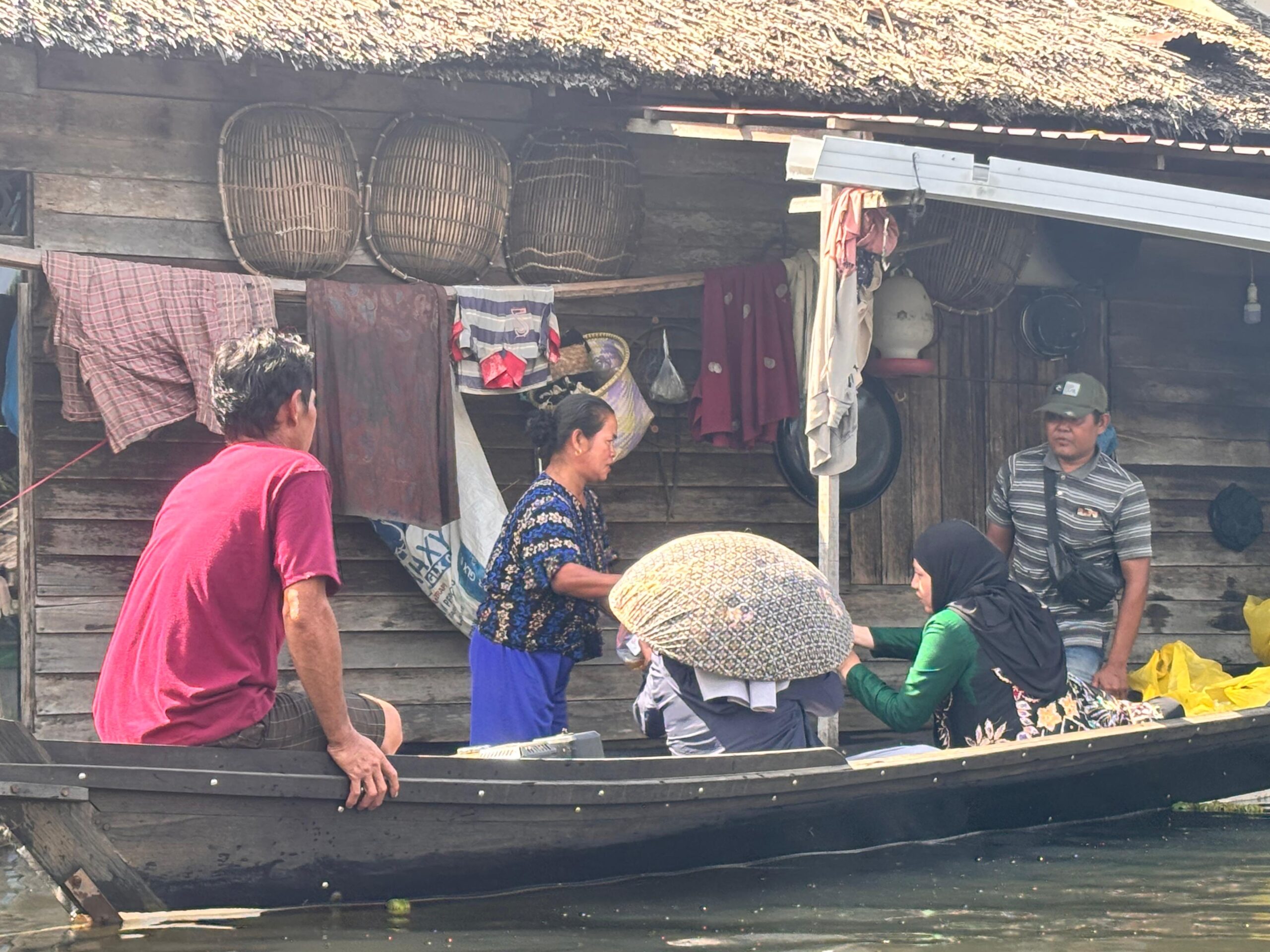
But statistics are cold; the reality of the distribution was warm, deeply human, and pierced with raw emotion. The team had prepared 80 Sembako Packages, containing the lifeline of any kitchen: sugar, oil, instant noodles, sardines, and hygiene essentials like soap and toothpaste.
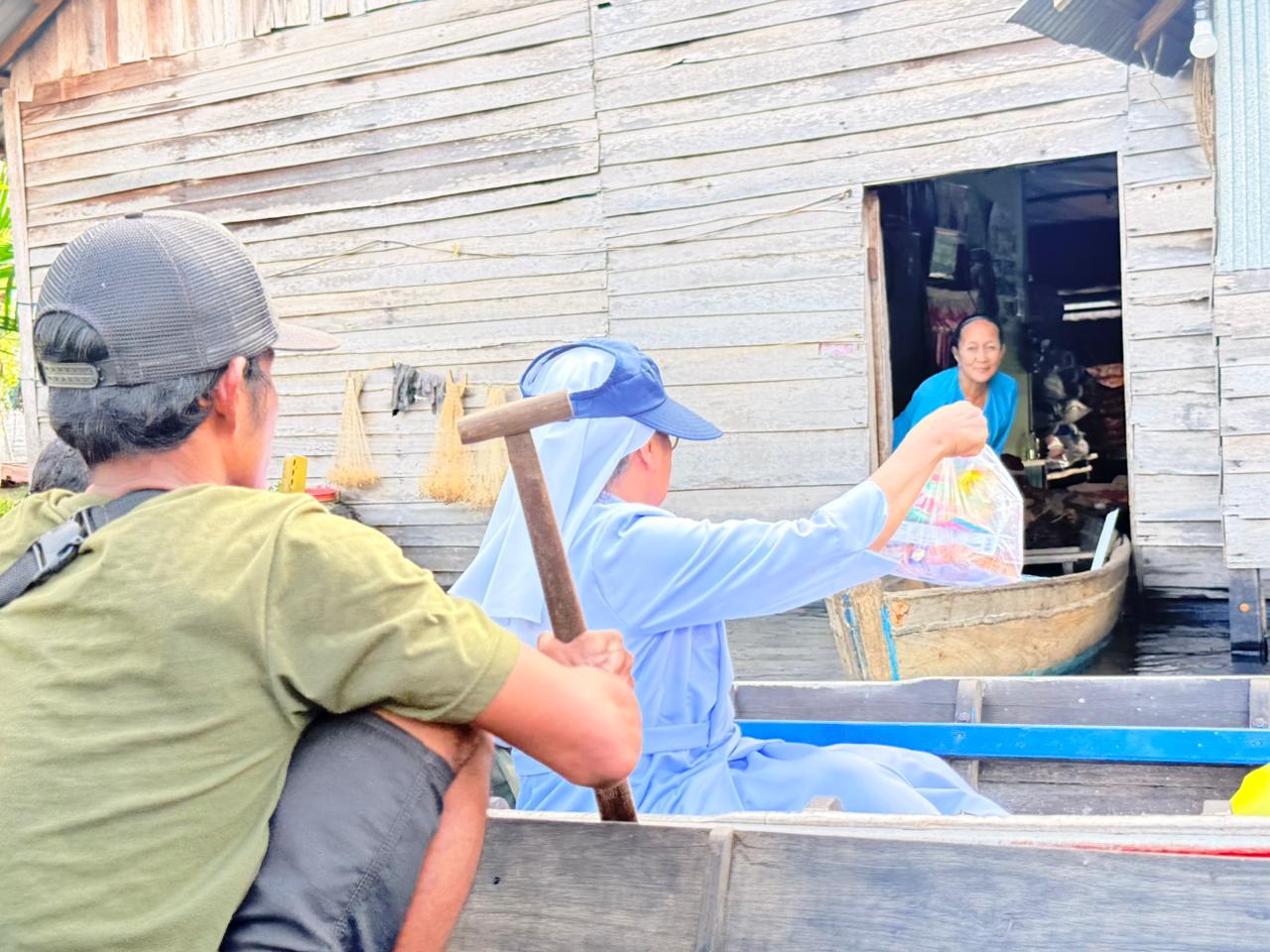
As the boats navigated the narrow, flooded alleyways, the abstract concept of “aid” transformed into personal encounters. One mother, her clothes damp and clinging to her legs, waded through knee-deep water to reach the side of the boat. She accepted the package with trembling hands.
“Sudah beberapa hari dapur kami terendam, tidak bisa masak apa-apa,” she whispered, tears mingling with the humidity on her face. “We haven’t been able to cook properly for days. This… this isn’t just food. It tells us that we are not forgotten here in the water.”
It was a sentiment echoed across the village. In a flood, where one’s home, the ultimate symbol of security, is breached by nature, the arrival of soap and toothpaste is more than hygiene; it is a restoration of dignity. It allows a mother to wash her children, to brush their teeth, to reclaim a small sense of normalcy amidst the chaos.
For the Children: A Wafer of Joy
The flood is perhaps hardest on the children. Their schools are closed, their playing fields are underwater, and the silent anxiety of their parents hangs heavy in the air. The relief team knew that a bag of essentials, while necessary, does not light up a child’s eyes.
So, they created 40 Special Children’s Packages. These were not about survival; they were about joy. Each pack contained a box of milk, a packet of biscuits, and a wafer.
As the boats pulled up, children watched from the verandas or peeked out from behind their parents. When Sister Imelda handed a package to a young boy perched on a wooden railing, his face broke into a wide, toothy grin.
“Susu! Ada susu!” (Milk! There’s milk!) he shouted, turning to show his friends.
For that brief moment, the brown, stagnant water around them faded into the background. The crunch of a wafer and the sweetness of milk became small beacons of happiness in a world turned upside down. It was a simple exchange, but it carried a profound message: You matter. You are seen.
Reflection: The Church Without Walls
This mission to Desa Sungai Pinang Baru was more than a humanitarian relief effort; it was a living reflection of the SPC motto. It demonstrated that the church does not exist solely within the stone walls of a cathedral or the sterile corridors of a hospital. The true church exists out there, in the humidity and the rain, balancing on a rocking boat, handing a box of noodles to a stranger.
The Sisters of St. Paul of Chartres, along with the staff of Institut Kesehatan Suaka Insan, showed that “Service to the End” is not a metaphor. It means going to the literal end of the river, where the roads stop and the water takes over.
As the team returned to Banjarmasin, the sun setting over the Martapura and casting long shadows over the water, they journeyed home with the quiet peace of a mission fulfilled—knowing that every resource entrusted to them had been transformed into hope. But they returned richer than when they left. They carried the smiles of the children, the relief in the eyes of the mothers, and the quiet satisfaction of Kadir, who saw his colleagues care for his neighbors.
Banjarmasin may be the City of a Thousand Rivers, prone to the rising tides of a changing climate. But as long as there are people willing to step into the boat and row toward the suffering, it will also remain a City of a Thousand Hands-hands that heal, hands that give, and hands that serve, all the way to the end.
The author acknowledges the contribution of the SPC Sisters, the staff of Institut Kesehatan Suaka Insan, and the generous donors who made this relief mission possible.