In an era where algorithms increasingly dictate the pulse of our interactions, the true challenge of the digital age lies not in the sophistication of our tools, but in our courage to remain profoundly human.
By: Sr. Herdiana Randut, SSpS (Author and Gender Activist)
Every year on May 17th, we observe World Communications Day. This is far more than a ceremonial date on the calendar; it is a moment of profound reflection on how communication serves as an instrument for human dialogue and the proclamation of universal truths within an ever-evolving world. For me, the 60th anniversary of this day serves as a milestone to examine whether our technological advancements are truly serving the common good or if they are, in fact, distancing us from one another.
Preserving the Human Essence
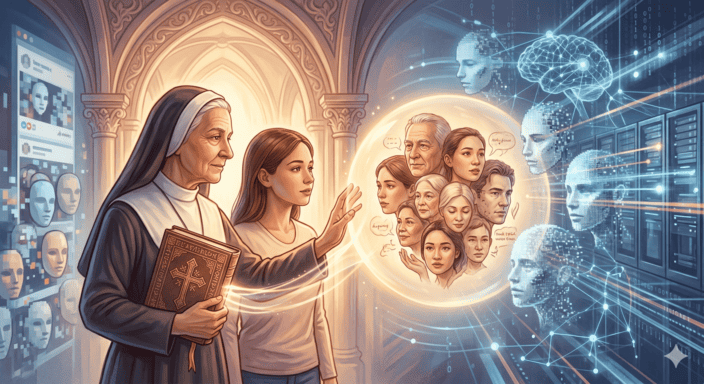
The theme for this 60th World Communications Day, “Preserving Human Voices and Faces,” arrives as a necessary alarm. Announced by Pope Leo XIV, this theme invites us to safeguard what is most personal: our voices and our hearts. Why is this “preservation” so urgent? Because in a world increasingly saturated by artificiality, the authentic human voice has become a rare and precious necessity.
Artificial Intelligence and the Limits of the Machine
We now inhabit a communication ecosystem dictated by technology. From the alarms that start our day to the social media feeds that occupy our meals, our rhythms are often managed by digital platforms. We see a growing tendency to prioritize digital “presence” over the richness of lived experience. This habitual reliance on the digital screen gradually erodes our trust in face-to-face encounters, making us more susceptible to edited narratives than to raw, honest reality.
This shift is driven by Artificial Intelligence (AI) and algorithms that simulate human conversation. While these tools are impressive, they carry significant risks: the violation of privacy, the erosion of critical thinking, and the mass replication of bias and disinformation.
However, we must remember that technology cannot replace the unique capacities of the human person: empathy, ethics, and moral responsibility. AI may process vast amounts of data, but it lacks a soul-driven sentiment. As beings endowed with conscience, we are called to be masters of our tools, not captives of our algorithms.
The Church’s Ethical Compass in the Digital Age
The Church seeks to provide a critical perspective, ensuring that the human person is not supplanted by a machine. Through the lens of Social Teachings, the development of technology must be evaluated by one primary standard: the protection of the inviolable dignity of every human being. Technology should serve to enhance our cultural and spiritual diversity, not to flatten it into a standardized digital code.
In conclusion, World Communications Day transcends technicalities; it touches the spiritual and ethical dimensions of our relationships. Communication is not merely the transmission of data, but the formation of a bond, a concrete expression of love. By “preserving human voices and faces,” we liberate ourselves from prejudice and ensure that humanity remains the center of all progress. Ultimately, it is the human face that reflects the Divine, not the cold glow of a screen.
Veritas Indonesia is committed to continuously presenting articles that strengthen faith and proclaim the truth. We invite you, our loyal readers, to support the operational needs of this ministry through a donation to BCA account number 6440054739 under the name of Lucia Margaretha Audrey Niron (Treasurer of Veritas Indonesia). To ensure your donation is properly received and recorded, please send the proof of transfer to our Content Editor, Maria Frani Ayu, at 081230038196. Your contribution, no matter how small, is a tangible expression of our togetherness in this ministry.