
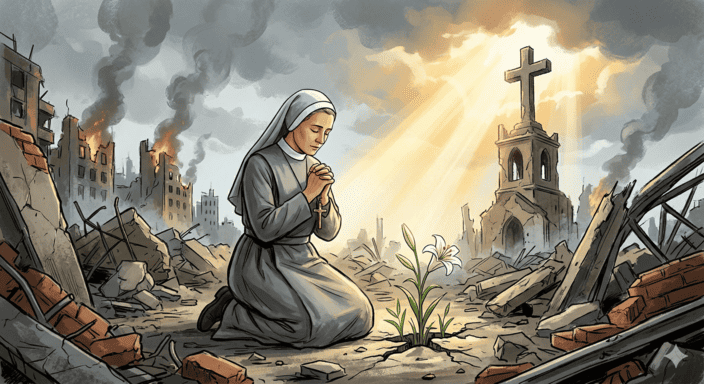
Amidst a world shattered by the roar of weapons and the ruins of war, is it possible for the cry of “Alleluia” and the joy of Easter to still echo with hope?
By: Sr. Herlina Hadia, SSpS*
Whenever the Holy Father appears on the Vatican balcony on major feast days, a powerful message often echoes across the globe, mirroring the greeting of the Risen Christ: “Peace be with you all.” These words reflect the Church’s deepest hope that the peace of God may truly reign in the world and in the hearts of every human being.
The Church is deeply aware that today’s world groans in its longing for peace. In these times, this greeting feels far more urgent: peace be with you, to those struggling to survive amidst the horrors of war, economic hardship, social injustice, and the fight to reclaim their human dignity. Yet, the question remains: how can one truly experience peace amidst such cruel turbulence of life?
Our world today is being torn apart by war. Some countries are devastated by its cruelty, while others feel its ripple effects. Countless lives have been lost; millions suffer; many must struggle just to find a bite of food or scavenge for remnants of memories among the ruins of their destroyed homes and cities. Ironically, amidst this tragedy, there are those who rejoice, feeling they have achieved their political goals. There are so many conflicting perspectives on war, yet Pope Francis, in his encyclical Fratelli Tutti (261), reminds us of one absolute truth: “Every war leaves our world worse than it was before.”
It is amidst this dark reality that Christians worldwide prepare to celebrate Easter. How is it possible for the joy of Easter to blossom from soil soaked in blood and destruction? What does it mean to sing “Alleluia” when our eyes witness unending violence and suffering?
At this juncture, Christians are called to rediscover the central meaning of the mystery of our faith. The Council Fathers in the document Gaudium et Spes (77) emphasized this calling: humanity is invited to cooperate, under the guidance of Christ the Author of Peace, to realize a peace based on justice and love. Peace is not merely a product of human diplomacy, but something realized under the guidance of the Creator of Peace.
The Cross Amidst Violence
To understand Easter, we must view the reality of human suffering today through the lens of the crucifixion. The crucifixion of Jesus Christ Himself took place within a context of political oppression and structural violence. At that time, crucifixion was commonplace; many were executed in this manner for breaking the law or being deemed a threat to the authorities. The leaders of that era lived under intense political pressure, and their decisions were often dictated by the fear of instability. It is within this historical context that the crucifixion of Jesus reveals how power, fear, and violence intertwine in human history.
In the worldview of ancient Israel, someone executed on a cross was seen as rejected by the community, cursed according to God’s law, and excluded from the covenant with His chosen people (Deuteronomy 21:23). This highlights the scandal of the crucifixion itself: being “hung on a tree” was not merely a shameful death, but also a sign of divine rejection and social exclusion. From human and legal perspectives of the time, Jesus appeared to be a total failure—rejected socially, politically, and religiously.
However, the cross essentially presents two realities walking hand in hand. On one side, it exposes the boundless cruelty of humanity; on the other, it expresses the infinite solidarity of God toward human suffering. Theologian Jürgen Moltmann, in his book The Crucified God, emphasizes that in the event of the crucifixion, God identifies Himself with those who suffer and are abandoned. Upon the cross, Jesus manifests His infinite love, bearing the burden of humanity’s suffering, which ultimately culminates in the reality of the Resurrection.
Therefore, the Church today must turn once again to the crucified Christ to show the world the true freedom He offers. The cross is not the final word on Jesus’ suffering. The cruelty at Golgotha, with all its violence and injustice, was unable to end His love. Instead, it is precisely amidst that suffering that God’s solidarity with humanity is perfectly revealed.
The Resurrection of Christ transforms what appeared to be a tragic defeat on the cross into an absolute victory for life and hope. Just as the empty tomb echoes the message that death and violence do not hold the final authority, Easter offers a blazing hope for those who today endure suffering, oppression, and the horrors of war.
Hope, Faith, and Prayer
In the encyclical Spe Salvi (2), the late Pope Benedict XVI reminds us: “It is not that they know the details of what awaits them, but they know in general terms that their life will not end in emptiness.” Faith and hope are two inseparable sides of a coin. Hope is equivalent to faith; faith is inherent within hope, and hope itself requires faith.
Celebrating the Resurrection amidst the ruins of war demands a hope rooted in complete trust—trust that God’s love is far stronger than death, violence, and despair. This hope does not turn a blind eye to the painful reality of human suffering, but rather affirms that God enters into that suffering, transforms it, and brings forth new life. Just as the disciples encountered the Risen Christ after surviving the trauma of the crucifixion, Christians today are invited to let hope guide their lives, becoming witnesses of peace in a world still scarred by conflict.
Then, is it possible for us to cry out “Alleluia” amidst the ruins? How do we do it? These are our existential questions today. Pope Benedict XVI provides the answer: the first and most essential setting for learning hope is prayer.
Prayer becomes the meeting space between faith and hope. Prayer lifts our gaze from the destruction surrounding us and entrusts us entirely to God’s love. It is from this hope, nurtured within the space of prayer, that the courage to cry out “Alleluia” is born. A cry that affirms that God’s power of life and redemption is capable of transcending even the darkest ruins of destruction.
The Risen Christ and the Call to Peacemaking
The Risen Christ greets His disciples with peace. He profoundly understands their fear and despair after losing the figure they hoped would be their defender. He stands in the midst of the darkness of human life and brings new hope—a hope that transforms suffering into the possibility to live again.
True life will only begin when the seeds of peace firmly take root in the hearts of those who have known conflict and violence, and when they voluntarily offer themselves as instruments of that peace itself. In this way, the Resurrection is not merely a promise of personal spiritual renewal, but a resounding call to participate in God’s work of reconciliation and healing in a wounded world.
The peace that was proclaimed by the angels to the shepherds at the birth of Jesus in Bethlehem is the exact same peace given by Christ Himself to His disciples after His Resurrection. Christians are called to live out this resurrection hope through concrete actions: solidarity, compassion, and active efforts to build peace.
Even amidst the ruins and the roar of war, the Church will continue to stand tall and proclaim: “Christ is risen. Alleluia.”
*Sr. Herlina Hadia, SSpS, is an Indonesian belonging to the Mission Congregation Servants of the Holy Spirit. She is currently pursuing her PhD at the Yarra Theological Union, University of Divinity, Melbourne, Australia.
Veritas Indonesia is committed to continuously presenting articles that strengthen faith and proclaim the truth. We invite you, our loyal readers, to support the operational needs of this ministry through a donation to BCA account number 6440054739 under the name of Lucia Margaretha Audrey Niron (Treasurer of Veritas Indonesia). To ensure your donation is properly received and recorded, please send the proof of transfer to our Content Editor, Maria Frani Ayu, at 081230038196. Your contribution, no matter how small, is a tangible expression of our togetherness in this ministry.